If you’re wondering how much it costs to build an ADU in Boise, you’re asking the right first question — and it’s the hardest one to get a straight answer to. As a Boise ADU builder, it’s the question we hear more than any other. If you’re still working out whether an ADU is even the right move for your property, our Ultimate Boise ADU Guide covers the basics. This article does one thing: breaks down what a real Boise ADU actually costs, using real project numbers, not industry averages pulled from another state.
The Simple Answer: Boise ADU Cost Per Square Foot
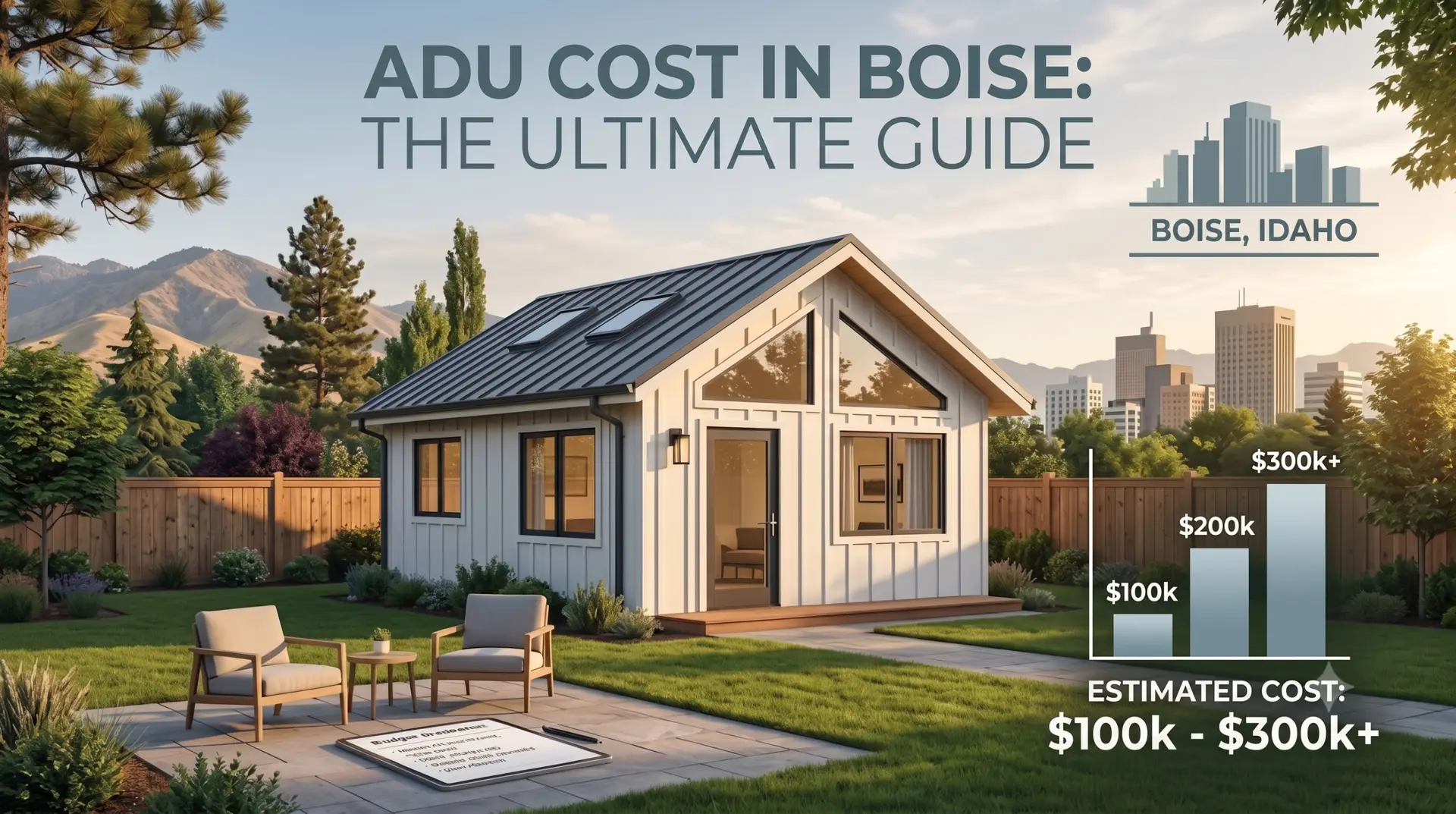
Most ADUs built by Mode Homes in the Boise area run $275 to $300 per square foot. That number covers labor, materials, permits, site work, and everything it takes to get a livable, code-compliant unit finished and ready for a tenant or family member.
Mode Homes primarily builds detached ADUs, and the pricing below reflects that scope. Other ADU types — garage conversions, additions built above an existing garage, or internal conversions — depend heavily on the condition of your home’s existing structure, which makes them much harder to fit into a clean per-square-foot number.
It’s also worth noting that we bill all utility, permitting and fee related expenses at cost to our customers. We find this transparency helps our clients with that part of the process which can have a significant swing in price from project to project.
Boise caps ADUs at 900 square feet, or 70% of your main home’s floor area, whichever is smaller. So the size of your lot and your existing home puts a natural ceiling on both your ADU’s size — and its total cost.
| ADU Size | Estimated Cost Range (at $275–$300/sq ft) |
|---|---|
| 400 sq ft (small studio) | $110,000 – $120,000 |
| 600 sq ft (1 bed) | $165,000 – $180,000 |
| 779 sq ft (2 bed, 2 bath — see real example below) | $214,000 – $234,000 |
| 900 sq ft (Boise’s maximum) | $247,500 – $270,000 |
Bottom line: A typical Boise ADU costs somewhere between $110,000 and $270,000 depending on size, with most projects landing in the $275–$300 per square foot range. Smaller, simpler units can land below that; larger units with more finish work can land above it.
What Drives the Cost Up or Down
Not every ADU costs the same per square foot, even at the same size. A few things move the number the most:
- Type of ADU. Detached ADUs — most of what Mode Homes builds — have the most predictable pricing, since the scope is consistent every time: new foundation, framing, roof, and utility connections, start to finish. Conversions and additions built off an existing structure (garage conversions, internal conversions, or space added above a garage) are much harder to put a flat range on, because the cost depends heavily on the condition of what’s already there and how much structural work it needs.
- Finish level. White vinyl windows, cottage lap siding, builder-grade cabinets, and flooring cost less than higher-end finishes just to name a few. This is one of the biggest levers a homeowner has to control their final number.
- Site conditions. A flat, easy-access lot is cheaper to build on than a sloped lot or one with tricky access for equipment. Demolition of an existing structure, trees, or concrete can add up quickly as well.
- Utility connections. How far your ADU sits from existing water, sewer, and electrical lines directly affects site work cost. Longer utility runs mean more excavation and materials.
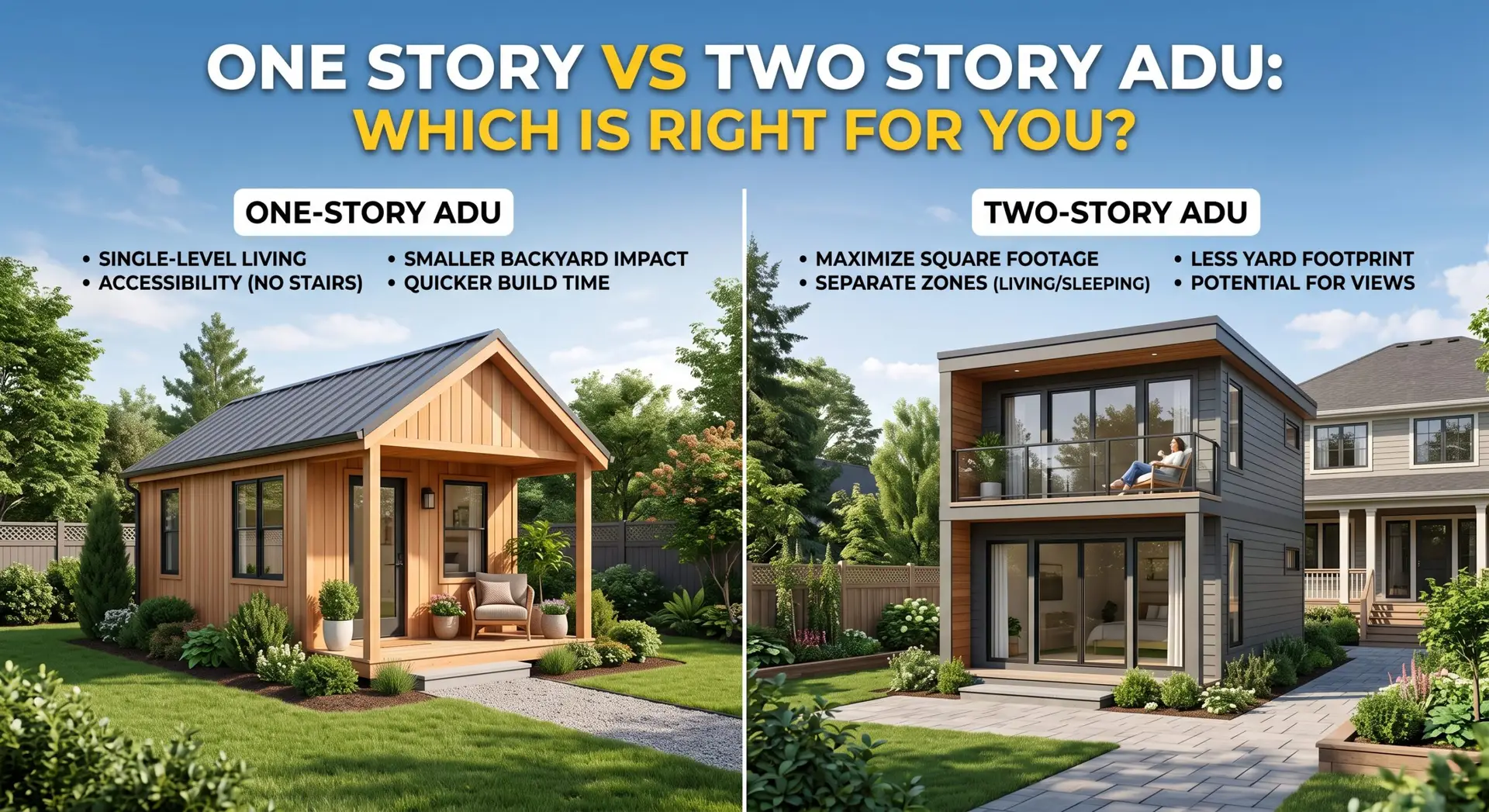
- Number of stories — two-story vs. single-story shifts where the money goes (more framing/structure, less foundation/site work proportionally), but the final $/sq ft stays about the same.
- Demolition and site obstructions — removing an old shed/garage, concrete, pavers, trees, or landscaping adds cost, and this extends beyond the ADU’s footprint since utility trenching often runs outside it too. Septic systems — sewer conversion requires properly abandoning the old septic tank; a new septic system requires engineering before construction can even start, adding time and cost up front.
- Architectural style — a simple rectangular footprint/roofline is most cost-efficient; foundation jogs and multiple roof lines look better but cost more.
A common underestimate: ADUs above an existing garage. One of the most requested ADU projects in Boise is adding a unit above an existing garage. It’s also one of the most commonly underestimated. Because the garage is already there, homeowners often assume this is the cheapest path to an ADU — but it usually isn’t. Building above a garage means reinforcing or replacing the existing foundation and framing so it can safely carry a second story, plus running new plumbing, electrical, and HVAC up into space that was never built for living. These projects typically run around $150,000.
A Real Boise ADU Budget: The Haven Model
To make this concrete, here’s a category-level breakdown from an actual Mode Homes project: the Haven model, a single-story 779 square foot, 2-bedroom, 2-bathroom detached ADU.
| Cost Category | Share of Total Budget |
|---|---|
| Preconstruction & General (permits, engineering, site setup) | 14% |
| Site & Foundation | 13% |
| Building Envelope (framing, roofing, windows, siding) | 24% |
| Rough-In (plumbing, electrical, HVAC, insulation) | 19% |
| Interior (drywall, trim, doors) | 7% |
| Finishes (cabinets, countertops, flooring, appliances, paint) | 22% |
| Final / Closeout | 1% |
Two things stand out here. First, the building envelope and finishes together make up nearly half the total budget — this is where most of the visible, tangible parts of your ADU come from, and where finish-level choices have the biggest impact on your final cost. Second, site and foundation work is a meaningful chunk of the budget before a single wall goes up, which is why site conditions matter so much to your final number.
Financing Ties In Here
Cost and financing go hand in hand. Mode Homes works with multiple local and national lenders with specific experience financing ADU projects in the Boise area — which matters, since not every lender understands how to underwrite an accessory unit.
What This Means for Your Boise ADU Budget
No two ADU projects cost exactly the same, because no two lots, homes, or homeowner goals are exactly the same. The ranges above are a real starting point, not a quote. The only way to get a number you can actually build a plan around is a project-specific estimate based on your lot, your goals, and your budget.
Want a real number for your property? Mode Homes can walk your Boise lot and put together a project-specific ADU estimate — no guesswork, no generic averages.
Frequently Asked Questions
How much does and ADU cost in Boise?
Most Boise ADUs cost between $275 and $300 per square foot, which puts a typical project in the $110,000 to $270,000 range depending on size. Boise caps ADU size at 900 square feet, or 70% of the main home’s floor area, whichever is smaller.
Is a garage conversion cheaper than a detached ADU?
Usually, yes. A garage or internal conversion reuses existing structure — walls, roof, sometimes foundation — so it typically costs less than building a detached ADU from the ground up, which needs its own foundation and utility connections.
What’s included in an ADU cost estimate?
A full estimate covers permits and engineering, site work and foundation, framing and exterior (building envelope), plumbing/electrical/HVAC (rough-in), interior finishing, and final finishes like cabinets, flooring, and appliances. We will permits, fees, and utilities at cost to our customers due to the complexity and variability for those costs.
What increases ADU cost the most?
Finish level and site conditions are the two biggest factors. Higher-end finishes (cabinets, flooring, fixtures) and a lot with a longer utility run or difficult site access will both push the final number up.
How much does it cost to build an ADU above my garage?
Typically around $150,000. This type of project is often underestimated because it looks like you’re just adding a floor to something that already exists — in reality, it usually requires reinforcing the foundation and framing below, plus new utility connections, which adds cost most homeowners don’t expect.