
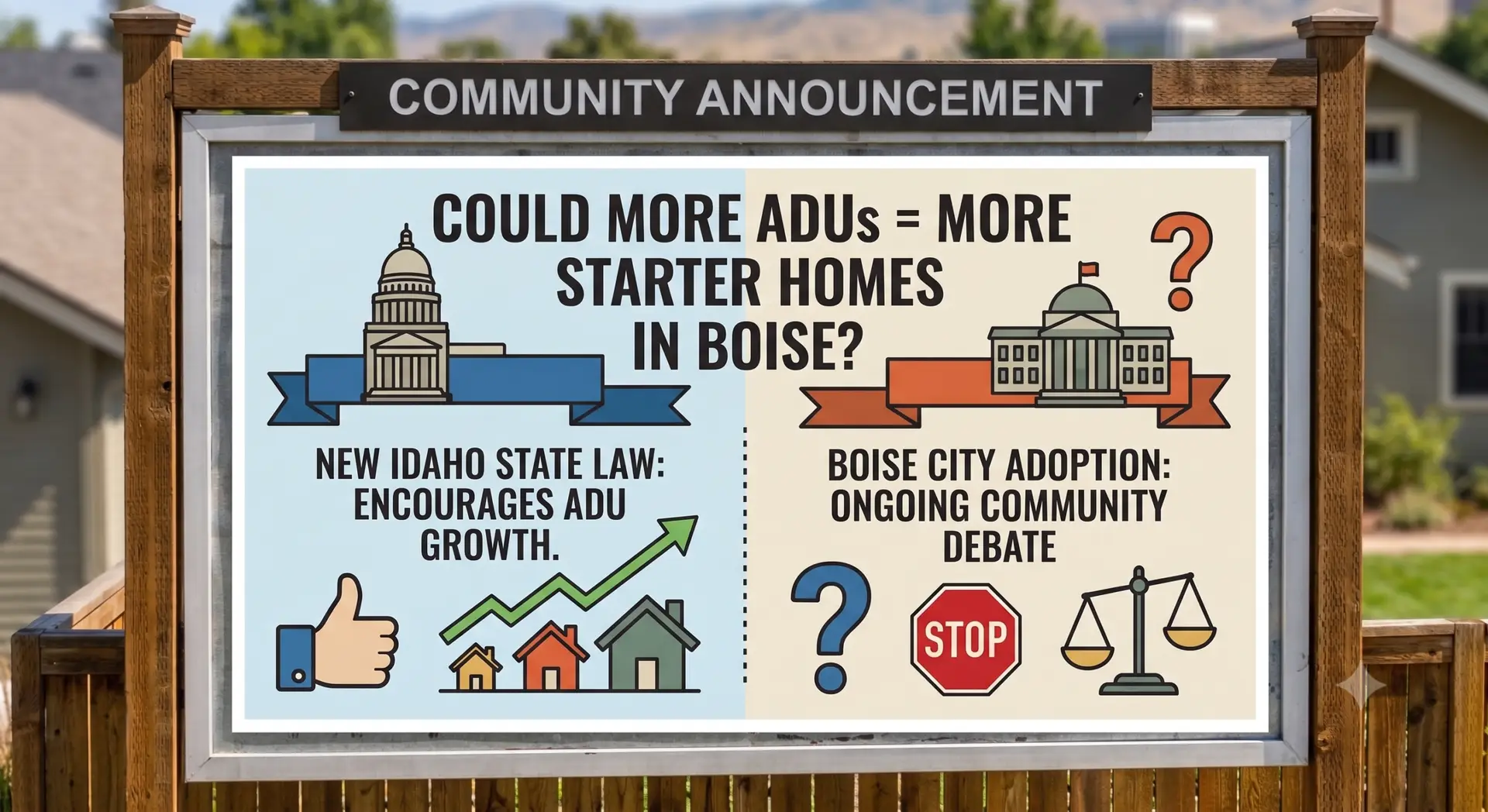
Idaho lawmakers passed a new law in 2026 that could change how homeowners finance and eventually own an accessory dwelling unit (ADU). It’s separate from the ADU legalization law that cities must follow by February 2027. This one is optional, and no city in the Treasure Valley has adopted it yet. If you’re new to ADUs in general, our Ultimate Boise ADU Guide covers the basics — this article is about the one piece of the puzzle still sitting on the table: separate ownership.
What the Law Actually Does
The law is Idaho Code § 50-1335. It lets a city or county set up a simple, administrative way to split one lot into two parcels — without going through a full subdivision plat. But it only works for one specific reason: financing an ADU.
Here’s the idea. Say you build a detached ADU in your backyard. Your lender may want the ADU on its own parcel before they’ll finance it separately from your main house. Normally, splitting a lot means a subdivision plat. That takes 9-15 months and costs real money. This law lets a city create a fast, simple, paperwork-light version of that split — but only for this one purpose.
Here’s the part that matters most: once that parcel is divided and recorded with the county, it isn’t just a bookkeeping change for a lender. It’s a separate, legally deeded piece of property. The financing letter is what triggers the city to approve the split — but the split itself creates something bigger than easier financing. It creates a standalone piece of real estate that can, in time, be held and transferred on its own.
This Law Is Optional — And That’s the Catch
Idaho’s main ADU law (§ 67-6541) is mandatory. Every city over 10,000 people has to allow ADUs by February 1, 2027, whether they want to or not.
This law is different. It says a city “may establish” the administrative division process. Nobody is required to adopt it. As of the zoning documents Mode Homes has on file, no city in the Treasure Valley — including Boise — has built this specific process into their code yet. Boise’s own newly adopted zoning code has a similar tool called a “Minor Land Division,” but it’s tied to a different program (housing incentives) and isn’t the same thing this law describes.
That means the real question isn’t “is this legal in Idaho.” It already is, on the state level. The real question is which city moves first to actually build the process this law allows.
Bottom line: Idaho gave cities permission to let homeowners split an ADU onto its own legally recorded parcel. At minimum, that means easier financing. At best, it means a truly separate, sellable starter home. No Treasure Valley city has built the process yet — the first city to do it decides which version Boise-area homeowners actually get.
Why This Matters for Entry-Level Housing
This law exists because ADUs are one of the fastest ways to add starter-home-priced housing in an already-built neighborhood. Financing has been the practical bottleneck — most ADU construction loans are tied to the whole property today. But the deeper problem is ownership: without a separate parcel, there’s no separate asset. Nothing to sell on its own, pass down to a grown child, or hold as a standalone starter home.
This law is the tool that turns “a unit in the backyard” into a legally distinct piece of real estate. Financing is the trigger the law requires to unlock the split — but separate, deeded ownership is the actual outcome. That’s a real entry-level housing option, created without a single new subdivision.
Two Ways This Could Play Out Locally
The state law doesn’t spell out exactly how far a city has to take this. Because of that, adoption could look pretty different depending on how a city actually builds the process — worth understanding both ends of the range before assuming one specific outcome.
| Scenario | What Happens | What It Enables |
|---|---|---|
| Minimum implementation | City builds the parcel split strictly for lender underwriting. The ADU sits on its own parcel, but the same owner holds both. | Easier, cleaner financing — the ADU can be appraised and financed as its own asset. Not offered for sale separately in practice. |
| Full implementation | City treats the new parcel as a genuinely separate, deedable piece of property from day one, with no expectation the two stay under one owner. | Everything above, plus a standalone starter home that can actually be sold, willed, or transferred to a different owner. |
Nothing in the state law requires a city to stop at the “financing only” version — a recorded, legally divided parcel is capable of separate ownership either way. But how local title companies, lenders, and the city itself actually treat that new parcel in the early days will decide how fast the “full” version becomes normal here. That’s exactly why it matters which city adopts this first, and how they choose to build it.
What This Law Doesn’t Do
This law does not create new buildable lots out of thin air. It doesn’t let you add density beyond what your zoning already allows. It doesn’t let you keep splitting the same property over and over — one division per property, and it has to be justified by an actual letter from a lender saying the split is needed for financing. It also doesn’t override your city’s existing utility, access, or building requirements. It’s a financing tool, not a density loophole.
What This Means for Boise-Area Homeowners
If you build an ADU today, you’re already up against one of the biggest hidden risks in ADU financing: the appraisal gap. Even with loan programs that credit the future value of your property after the ADU is built, appraisers still aren’t used to valuing ADUs, and there isn’t much comparable sales data to work from yet.
We saw this firsthand recently. A home appraised at $500,000 as-is came back at $565,000 after adding a 750-square-foot, 2-bedroom, 1.5-bath ADU — in one of Boise’s most desirable neighborhoods, where real estate consistently trades for $350 to $400 a square foot. At that rate, the ADU alone should have added somewhere in the range of $262,500 to $300,000 in value. Instead, the appraisal only credited about $65,000. We’re appealing it now.
This is exactly the gap this new law is built to close. Right now, an appraiser looking for “comps” has to hunt for other houses that already have an ADU on the property — and there just aren’t many of those in Boise yet. The similar properties that do exist are not being sold. Once an ADU sits on its own separate parcel, that search changes completely. Instead of chasing rare ADU-specific comps, an appraiser can compare it directly against Boise’s existing supply of small 1- and 2-bedroom houses — and there’s a lot more of that to work with. Once the statewide 1,000-square-foot cap takes effect in 2027, that comparison pool opens up to small 3-bedroom homes too. Appraisers get pushed toward comparing your ADU to real, existing housing stock, instead of guessing based on almost nothing.
We’re watching for the first Treasure Valley city to adopt this process, because it’s the moment ADU appraisals in this market start to catch up to reality.
Thinking about an ADU and worried about how it’ll appraise? Talk to Mode Homes. We’ve been through this exact appraisal fight ourselves and can walk you through what to expect before you build.
Frequently Asked Questions
Has any city in the Boise area adopted Idaho’s ADU ownership law?
Not yet, as of the zoning code documentation currently available. This is an optional law, and cities have to choose to build the administrative process themselves.
Is this the same as Idaho’s ADU legalization law?
No. The legalization law (§ 67-6541) forces cities to allow ADUs by February 2027. This ownership/financing law (§ 50-1335) is separate and optional, and it deals only with splitting a lot for financing purposes.
Does this law let me sell my ADU separately from my main house?
It depends on how the adopting city builds the process. The law allows for a fully separate, deedable parcel — nothing requires common ownership afterward. But a city could also implement it narrowly, mainly for lender underwriting, with both parcels staying under one owner in practice. Once a local process exists, confirm the specifics with a real estate attorney or title company.
Can I finance an ADU right now, even without this law being adopted locally?
es, financing options already exist today. Just know that appraisals are the weak link right now — appraisers have limited ADU comps to work from, so get a lender experienced with ADU projects and go in prepared to push back if the appraisal comes in low.
Why do ADU appraisals often come in lower than expected?
Appraisers typically look for comparable homes with an ADU already on the property, and there aren’t many of those in Boise yet. That forces low, inconsistent valuations. Once ADUs sit on their own separate parcel, appraisers can compare them to existing small houses instead — a much larger, more accurate comp pool.